Oasis of Life

Picture of life inside a tidepool

At the corner of 17th Avenue and Broadway, a young man built an oasis into his condominium. The tall corner window stretches floor to ceiling and a red snapping turtle swims lazily, turning to watch puzzled passersby. I peek through the window and see wide fountains and housebound pools. Succulents stretch over bookcases, creek stones, and a long-abandoned guitar. Life explodes in there, its momentum spilling under the door frame and through the cracks in the caulking. It strikes neighbors and pedestrians with the urge to stand still and quietly overflow with emotion. Girls on cell phones and secret amphetamines walk by. They stumble in their animated conversations, never sure what has shaken them.

Musical Inspiration: A Shoreline Dream – Peel You Open.  No real background to this story, except to say that I would probably not want to be this guy’s downstairs neighbor.

0no comment

An Abandoned Changeling

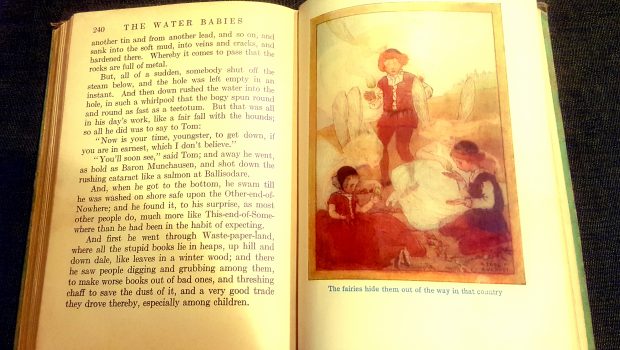
Image from the book "The Waterbabies"

[This is a sad story, and I wish it wasn’t true.]

In Iowa, the fairies came out in spring, building temporary homes in melted snow pooled between half-buried tree roots, bordered by mud and moss. Walking home from school, I’d peer into tiny caves formed by icicles dripping into snow banks. Fairies glinted in these shadowy caves, but then I’d blink and see only snow crystals. As spring progressed and their homes dissolved, the fairies fled to the scarlet tulips and delicate lilies-of-the-valley lining the brick path to the vacant lot.

On a sunny May afternoon, Jenny and I held a fairy tea party. Leaves for plates, acorn tops for cups, and a feast of clover, sheep sorrel, and chamomile. Jenny was fairy-like herself, with her pale, delicate features and bird-like movements. I was taller, more solid, tanned and strong. Afterward, we lay on our backs in the grassy vacant lot and closed our eyes in the sun, watching red and black pictures form on the insides of our eyelids.

“What do you see?” she asked.

“A witch,” I told her. “No … a genie. In a bottle. She has long red hair and is dancing slowly.”

“A genie like the one on Scooby Doo?”

“Kinda. But her eyes are more slanted, and sometimes they are on the wrong part of her face.” When the genie smiled, her teeth were sharp like a cat’s. “What do you see?” I rolled over. Jenny’s eyes were open and staring into the wan blue sky.

“God.”

“God?” I asked, puzzled. “What’s He doing?”

But she didn’t make sense after that. She only said parts of sentences, and then repeated herself under her breath. When I complained, she said that the doctor called it “echolalia.” “I can’t help it. It’s hereditary,” she said, not missing a single syllable of these strange new words.

“What’s that mean?” I watched the lilies-of-the-valley swaying at the foot of the rock wall, the one we were supposed to stay away from because of the snakes there.

“It means Mommy does it, too.” She paused. “I’m not supposed to do it.”

…posed to do it,” she whispered again.

“Oh,” I said.

…oh.

In October, they sent her to a special school. When she came home to visit, I asked what she did there. “They make us sit in a room and draw things, and we’re supposed to talk, but I don’t know what to say.” She pulled on her braid and wrinkled her nose.

“Did you tell them you see God?” I asked. We were standing under the big sycamore tree in her yard, poking the tree roots with sticks, although the fairy pools had long dried.

She rolled her eyes and went back to scratching in the dirt. But we didn’t dig up any fairies, so we walked back to my house. When we got there, I peeked around the kitchen corner. My mom seldom had guests, but Jenny’s mom, skinny and wild-haired, rocked in my grandmother’s rocking chair, holding a steaming cup. My mother was quiet and wore a funny expression, like she wanted to say something nice but couldn’t think of anything.

“I tried to run away,” I heard Jenny’s mom say. But then they saw us and made us play upstairs so they could discuss grown-up things they thought we wouldn’t understand. So we trudged to my room and flopped down in front of the dollhouse. I picked up my Ken doll and turned to Jenny. “What was your Mom running away from?”

“My dad, I think,” Jenny said, brushing Barbie’s hair, even though it was actually Strawberry Shortcake’s comb.

“But why?”

“He made me touch him in bad places.”

I walked Ken up the dollhouse stairs to the closet, where I made him take out a new coat and tennis shoes. I put the shoes on Ken. “Why did he do that?”

She shrugged, not looking at me. “It felt good, I guess.”

I didn’t understand what she meant, exactly, but sensed something unforgivable, the kind of thing that grown-ups don’t want to talk about when kids are around.  But her face was expressionless like a doll’s, and she grew still.  I was confused and didn’t say anything except, “Oh.”

…oh,” Jenny repeated.

Ken walked back down to the kitchen and said hello to Skipper as he passed. He waved to Barbie, but Barbie was busy in Jenny’s beauty parlor.

“Are they going to send you away again?” I asked.

“...away again?” She set Barbie on the dollhouse sofa and stood up. “Probably. They always want to send me away somewhere.”

They did, and I did not see her again. These days, however, I prefer to think the fairies took back one of their own.

***

Musical Inspiration: Playing in the background and inspiring my phrases was the elegant ambiance of Numina. I won’t pick a particular song since they’re all so intertwined. Check out Numina’s beautiful album “Symbiotic Spaces” to hear one of my favorite artists.


0no comment

Refuge

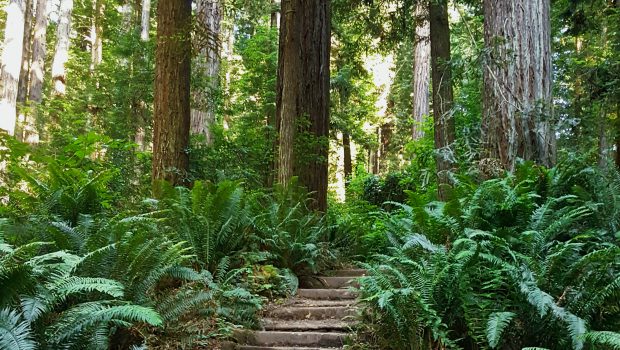
Picture of wooden stairs leading into redwood forest

Mountain leaves and palindromes; the girl could not create one from the other. “I give up,” she said, bowing her head to the old man. “All my answers are wrong. I don’t know how they are alike.”

He grunted and shrugged. “Keep walking,” he told her, “and you’ll see.”  He quietly shut the door without even a final nod, and she knew it was useless to knock. The door would not open to her again.

No one missed her when she left.  As she walked she turned her scarred face in greeting to the sky, letting her village grew tiny behind her. Its bright noise dwindled; the children shouting, women chattering at the marketplace, and carts rolling over the stone roads all grew faint and then silent. The sun rose above her, and once she leaned against a cliff wall to eat a bit of potato from her provisions. Her fingers toyed with the small piece of chalk at the bottom of her bag. She straightened and withdrew the chalk, writing a poem on the rough rock as neatly as she could, as the ancient wild sages had done. She knew that time would dissolve her words.  Like all things, the poem would be vivid for a day, then would fade back to sand and dust. It was a palindrome, in a way, riding the same path backward and forward.

The sun lowered to the horizon. She gathered meadow grass into a bed and started a small fire. Her sweat smeared the dirt on her hands, like watercolors. She imagined the droplets rolling down the mountains as she labored. Her old green coat stank with smoke and her unwashed scent.

She lay on her back, counting constellations and listening to the rushing stream.  Perhaps by now her mother had noticed her absence but would say nothing to her father, who would not care about a missing daughter too ugly to marry off or sell. The moon and stars saw only the land below them, all creatures blending into the whole of the earth.

The fire warmed her and she let her eyes close. She knew she’d die in the coat she wore, but one battered green coat can hold many years in its pockets.

***
I found this little piece I wrote a couple of years ago and sadly, I don’t recall which song went with it. When I wrote this, my goal was to make it to August without any death. I could make a little graveyard here of all the people who have died on my blog. I think that makes me a horrible, horrible murderer in a literary sense. I will reform, I promise. Or at least, that’s what I said at the time. You be the judge.


0no comment

Coyote Spirits Got the Moonshine … Again

Picture of "Do Not Feed Coyotes" sign

I stumbled out of the sleeping porch, rubbing my eyes. Granny spoke before I could even say good morning. “It’s them damned coyotes,” she said crankily. “Drinking the moonshine–the thieves!–and from the sounds of it, they got themselves some of the funny weed, too.”

She knew I already knew that. She knew I could see right into their skulls and out through their spirit eyes ever since I was a baby. And since there was no denying the racket of the coyotes, and because she hated my “it don’t come from Jesus!” ability, she pretended that I needed to be told. And I pretended along with her because I knew it made her feel better.

I walked to the dark window and stood grinning with my back to her, watching the little transparent figures that Granny could hear but only I could see. They were cavorting, which was a new word I learned in school last week, and yipping. Through their eyes I could see them as explosive rainbows, shimmering cartoony-dogs chasing their own tails and rolling around on the ground, melting into each other. To them the dirt was a great big carpet of scents, like the prairie on overdrive with enormous rabbits and stupid, fat cows lying lazy and unprotected on the grass. Poor cows.

I stifled a giggle while I listened to the tinkling of Granny doing the dishes underneath the flickering bulb light. She humphed. Oops. I didn’t stifle enough. I quietly slipped the latch and walked into the backyard.

One of them noticed me and licked my nose with a flowering tongue, bright purple ears impossibly long. “I LIKE FOOD!” it said in sing-song, ears twisting around my shoulders. The others whooped in joy and echoed him, building a weirdly harmonious symphony of “I LIKE FOOD!” Their paws pounded out the same fast drumbeat, and their noses pointed into the wavering sky. “Food food food FOOD!”

I don’t know why but their silly songs and nonsense yelps made me think of Barney, the big purple dinosaur on kids’ TV. And of course, because I thought of him, there he appeared in their midst. The coyotes froze for a second and then resumed their dancing, and Barney jigged in time to their coyote symphony. Barney liked food, too, or so he claimed. The more they sang about food, the more food piled up around them. Kinda gross, really, since a lot of what coyotes eat is roadkill and dead things, and dinosaurs eat really big, funny-looking roadkill. But through their spirit eyes, it looked like the most delicious morsels, better than ice cream or fried chicken.

(What they think of Granny’s fried chicken is a story for another day.)

“You stop that laughing!”  Granny shouted sternly through the screen door. “It ain’t funny!” But she stalked off into the living room. Of course it was funny. It was freakin’ hilarious. And I laughed so hard that the coyotes started laughing at my red face and gasping guffaws.

I suppose I shouldn’t have encouraged them while they were “partaking in illegal substances,” as my teachers often said, but honestly, the Pope himself would have laughed himself straight to Hell if he saw this. And he wouldn’t care, probably. Nothing’s illegal to a coyote.

***

This is otherworldly music of the humorous sort. I love Animal Collective and especially the song that inspired it, “We Tigers.” This little fan video amused me greatly.

Photo “Do Not Feed the Coyotes” by Adactio/Jeremy Keith.

0no comment

The Stories of Harpies and Humanity

Cover of Empire of the Sun's first album

Thirty miles outside of Crescent City, we ran out of gas. The van had been sputtering for the past 400 miles, and I recognized imminent engine failure. We stepped out, stretched, and wandered the edge of the forest for a bit, touching the huge tree stumps and staring at roadside litter and light poles, doing all those things that happen only when you’re in between places and suddenly struck motionless. These experiences aren’t cataloged in anyone’s “100 things to do before I die” list; you hurry through them so that you don’t have to hear the silence around you and your brain’s desperate, stupid chatter.

Then we waited for the harpies to descend because of course, they were going to. They had promised they’d never cease following us and would always search for our moment of vulnerability. I had laughed at the time, knowing them capable of only impotent fury and ridiculous swooping war dances, shaking their blood-stained feathers. But in a world where no one remained and reality was disintegrating at our feet, even comical rages were welcome. Maybe they’d finally found a way to suck our “maggot hearts through our defiled eyes.” I chuckled as I thought of that–their most recent threat–hurled to us between road signs in Ohio. Carmen had choked on her coffee when she heard that one.

She turned to me now as we watched the brilliant purple sky grow brighter. “I used to be afraid of dying,” she murmured, pulling her coat around her.

“And now dying just seems like another story told by someone who wasn’t you,” I replied.  “Like, ‘Poor Carmen. She was so beautiful with her raven black hair, and she died so tragically. Nothing but bloody bits fading away into homeless atoms.’”

“Why is black hair always compared to a raven? I mean, sewer rats are black, too.”

“Fine, then, her sewer-rat black hair fading away into a quantum void.”

“A void of tragedy!” she giggled.

“Yes, yes, a most tragic void!” I concurred.

She nodded approvingly. “Just a lone human in a void. And what’s a human being, anyway? I think we’re just one story after another.”

I pondered this. “Yeah, and they used to call that ‘life.’ You know, back when there was a They.”

I suppose at this point, observers would have considered us mad and shell-shocked. You know, those hypothetical people forgetting their own stories for a moment so that they could immerse themselves in ours. I used to do that, embracing the illusion that I could shut off my own story for a few hours by watching TV, reading the celebrity gossip pages, or just listening to someone bitch about office politics. But our current gallows humor wasn’t madness. It was astute.

I twisted my scarf, the cool fog of the Pacific Northwest saturating me and giving the illusion that the world was disintegrating into mist. Except these days, you couldn’t really assume anything was illusion.

Carmen nudged me in the ribs. “I see them.”

I clapped my hands to my head. “Good God! They’ve caught the scent of our maggot hearts!”

And as the sky clouded not with water vapor but the writhing, hateful bodies of the harpies, Carmen and I clutched each other in laughter, even though we could see that the harpies had changed. No useless rage now, but instead they came with an arsenal for slicing, dicing and frying our fragile human skins and brains.  No joke now. Their tiny eyes gleamed from beneath their thick brows, claws dangling some poor creature’s entrails soon to be replaced with our own. Our surroundings disintegrated fully now as they landed, and our stories and our guts left our bodies.

It was all right. Someone’s always waking up with a new story in their head, anyway, reanimating a worn old tale into a modern-day marvel.

——————-


Musical Inspiration: “We Are The People” by Empire of the Sun, my official Happy Band. You will probably watch their videos and laugh … and then you realize you’ve watched the same video eight times in a row because it’s so damned awesome. Then you call your friends over to see the video, and they’re standing behind you going, “WTF is this?” But the next time you see them, guess what’s playing in their car?  The songs inevitably have pop sensibilities, and then the vocals soar in that silly but beautiful falsetto, and you realize it’s just as serious as it is ridiculous.  Hmm, like the little piece above.

Photo: Empire of the Sun website

0no comment

Junkett Hauser

Picture of bench overlooking ocean sunset

The old man kept a jeweled caterpillar in his shirt pocket and only took it out for frail girls with haunted eyes and thrift-store sweaters. My mother saw it when she waitressed at the little Hungarian restaurant on 44th street in the City. She said it hummed like a cicada in her ears, first left and then right. The old man finished his coffee, and she followed him as he shuffled out. He turned towards her with the larva in his hand, and the little creature rose on its many hind legs. The wet streets lit with its kaleidoscopic colors, and each illuminated raindrop whispered a dream that every child must forget.   Red light, trapeze. Blue light, marionette. Green light, curtained stage. Violet light, top-hat man. Silver light, acheckerboard floor. Magenta light, the mechanical brain encased in flesh.   Golden light, the emptiness of form on your fingertips.
She froze, fixated on the caterpillar, and was still motionless long after he disappeared around the corner. When she came to hours later, she had written “Junkett Hauser” on her order pad, right under “French fries with brown gravy, Coke.” She never knew if that was the man’s name, the place he came from, what the caterpillar liked for breakfast, or what. Then she was fired for walking out of her job.“And that was ok, honey,” she said years later, “because then I got that job as a go-go dancer –god, I was so embarrassed but I needed the rent money and it was a really swanky club!– and I met your father there. Now here you are, playing in my old go-go boots, so wasn’t that a good thing to have happened?”When the old man sat beside me on the park bench twenty years later, I understood something right away.  They had a symbiotic relationship of sleep and wakefulness. The warmth of his chest lulled the caterpillar to sleep, and the glow of its lights awakened the old man back into youth. And as I shivered in the fog, pondering this, I watched the sun set and rise on Golden Gate Park. One day had passed, a day of my youth that he deftly plucked and nestled next to Mother’s in the magenta jewel on the caterpillar’s back.

***

Musical Inspiration: Maelcum’s Righteous Dub by the Changelings. This is a photo of the glorious Big Sur, rather than Golden Gate Park in San Francisco.  Both are remarkable places, but I think Big Sur is a downright sacred place. This photo was taken in one of Big Sur’s Christian holy spots: the New Camaldoli Hermitage.

0no comment

Loyal Friends and Light Portals

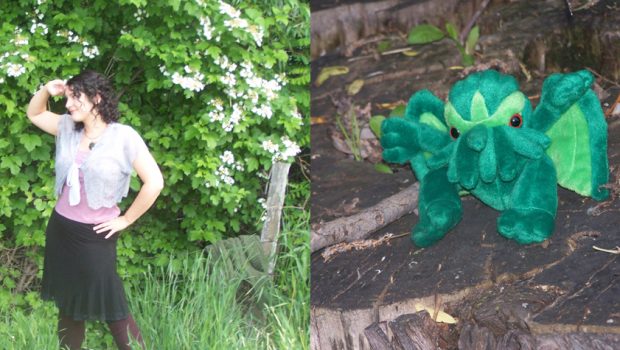
Girl not looking at hideous beast, which is actually a plushie

At midday, Becky races through the tree-lined streets, pack swinging and bubblegum snapping.  She’s vowed to arrive on time to chem class. Her skirt swishes at her knees and she smiles at the street bums, singing with the airy pop song playing through her headphones. A palm-reader once claimed that Becky’s life purpose was distributing joy to God’s creatures, and her bliss-generating duties are keen: dazzling smile, soaring soprano, and endless encouraging words.  But watch out, Becky!  A light portal crossed your path! One sneaker-clad foot sinks into liquid transdimensional light, which feasts first on bone, then on flesh.  Oh dear, that’s the end.  Regrettably, these light portals originate from a mean dimension. They dislike joyful souls. They glitter prettily in the sun, but they’re greedy things, always manifesting at inopportune times and gobbling up organic molecules, the sweeter the better. Her shoes melt, and her eyes freeze in disbelief and bodily failure. Her headphones bleat as the metal wires corrode, but the plastic remains whole, synthetic and safe.  The pop song dissolves and abandons its linearity, but Becky’s melting brain ruins her cognizance of this metamorphosis.

I saw it all, Professor! I, her loyal friend, was helpless to intervene. It was awful, especially because she’d worked on her term paper all night. I’ve been crying all morning! One of the theoretical physics students thinks he can retrieve her with a complicated quantum formula and a particle accelerator. If he’s successful, you don’t mind if she drops off her paper late, do you? We’ll just slide it under your office door. I’ll make sure she washes her hands really well so the light doesn’t get into your files.

***

Musical Inspiration: No. 6 Von Karman Street by A Sunny Day in Glasgow.  Chaotic, yet perky and undoubtedly assailing any synaethesic listeners with a shower of unrelated colors and tastes. It’s like someone took an old-school shoegazer song and applied the literary cut-up technique to it.

As I wrote this, I couldn’t help but think of the numerous boho Instagram accounts featuring beautiful young girls in feminine clothing doing romantic things like twirling in a meadow or draping themselves artistically across old furniture.  My morbid side imagines an unfortunate future for the beautiful girl.  The furniture sprouts teeth and devours her, or the tranquil meadow turns into a howling abyss from which the Old Ones emerge (she’s snack number one of 6.5 billion).

My attempt to recreate the latter scene is in the photo above. Fortunately, I have yet to be eaten by the plush Cthulhu.

I’ve given up on making excuses for my brain.  I just let it entertain me.

0no comment

The Tulpa

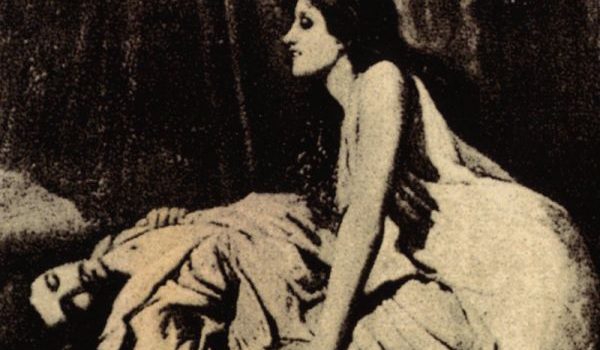
1897 painting of a female vampire hovering over a man's bed. It's not looking good for the guy.

I spent 1917 in a series of anonymous seaside cottages, bunking with proper socialites so that I might press their gowns and wash their teacups.  The daughters of London lords taught me to summon Baphomet, and I taught them to hex each other’s tea.  They had not been sent to learn such low-brow spellcraft, but the convenience of sympathetic magic wormed its way into their drawing room studies.

I think of those girls now, in their white frocks and tidy pompadours, and wonder if any survived.  You must forgive their mothers and fathers for sending them to such ungodly study.  In those times, young women of means had only marriage to aspire to, and the War had already devoured so many eligible bachelors.  A certain kind of free-thinking parent might send a bright young woman to learn the ways of the occult, ensuring her independence and safety by way of the will and the mind only.  And of those noble qualities, these girls were greatly blessed.

And a certain kind of schoolmistress might take pity on an orphan girl like me and wish to save her from the indignities of the streets and the men that congregate there.  She might, from good intent and kindness, give the child a too-large maid’s uniform and a bed of straw in the lean-to, seeing nothing but the girl’s sweetness and little of the girl’s cunning, created by generations of village witchery.

To say I did not mean to create… it… would be untrue.  To say I did not intend its effects would be more accurate.  If a young lady spoke snidely to me, I would turn a quick hex as my great-aunt had taught me.  Then fearfully thinking of my parish priest and his dire warnings, I would throw the ugly, ephemeral thing in the corner of our bunkhouse where its bright red light would dwindle as I watched.

But the hexes did not die as I believed. Rather, these dying embers of vengeance and spite congregated and grew under the floorboards.  If I had attended the lectures with the students, perhaps I would have guarded against this.  Instead, I scrubbed their garments outside the open windows of their classrooms, catching half-phrases and incomplete diatribes.

What did the hexenbeast do, I wonder, all those years?  As I grew into a bewitching woman with ever-increasing power and none of the constraints of nobility, what was it doing?  Did it travel to far-off lands to feed off the mad and the shell-shocked?  Did it don rolled stockings and long beads and dance the Charleston, driving starlets to suicide and automobile accidents?  Did it stalk the refugees of the Dust Bowl, blowing the Black Blizzards into the minds of poor farmers’ wives?

Did it dare enter Germany during its dark years?  France?  Spain?

I cannot bring myself to think of it.  I know its excesses fed me, though I did not understand at the time and thought my allure and financial power to be wholly self-made.  And in a way, I was correct, for I made that hexenbeast, that tulpa.

Away for so many decades, the tulpa has now returned to its creator.  It lurks behind the grandfather clock, ostensibly doing little but ‘breathing” in my earshot.  It does this deliberately and unnecessarily, as it has no organs or breathing apparatus.  It waits for a command but I’ve grown so old–so very old–that I don’t recall what I must tell it, my indecision dooming it to an eternity of bated breath.  It is a pitiable creature, but there is nothing to be done, save to ignore it.

Over the past several months, those young ladies at the summer cottages troubled me.  I had a mind to use the power of this “Information Age” to look them up, old as I am. I stopped after the fifth girl I could recall.  None had survived past age forty.  One of particular beauty and cruelty had died in a madhouse as it caught fire.  If others are still alive, I do not want to know of them.

The surf crashes below my house, the sky a permanent gray.  I have learned, of course, that there is no God, only spirits more good than evil.  They will not speak to me now, not with that creature constantly near.  Therefore, I have no one to confess to, and no one to absolve me.  I have thought of suicide, but my tulpa’s presence feeds my vitality and I start to wonder if perhaps I cannot die and if this is the eternal state of my existence.

And if that is true, without direction, we will remain together in this fearful stasis forever.

I must give it a task.  Cautiously, I offer innocuous but challenging activities.  Its breathing does not change. It does not respond until out of desperation I shout, “Make a proud and lovely girl hang herself!  There!  Is that what you want, you loathsome thing? To feed on the vibrant and healthy?”

Yes, my mistress, it hisses.  Thank you, my mistress.

***

Music influence: Oingo Boingo’s “Insanity.” While I think the radio edit totally mangled the song (a black magic song if I ever heard one), the creepy video successfully depicts the festering underbelly* of religion, politics, and social norms. Stop-motion video just lends itself to creepiness.  It’s hard to know how to classify this song.  Oingo Boingo‘s often known as a New Wave band, but this is practically gothic.


Photo Credit: “The Vampire” is by Philip Burne-Jones, 1897

0no comment

The Parthenogenesis of Mabel the Teenage Komodo Dragon

I have always loved Komodo dragons … from afar. Parthenogensis in Komodo dragons is a real phenomenon.

Poor Mabel.  It was just unfair that she was so decidedly ugly and unpopular a Komodo dragon.  She had tried to make herself prettier by rubbing her cheeks against red clay, but the other girls snorted and advised, “It doesn’t matter how much makeup you wear–you’ll never be pretty.”  She had tried to diet, restricting herself only to grubs and mice, but she grew faint and collapsed on top of Elder Mahoney, breaking the old dragon’s hip.  For awhile, she had even spelled her name “Maybelle” in hopes of seeming more sophisticated, but the plan deteriorated when she realized that only she and Elder Mahoney could read.

Now, she poked her head out of the family burrow.  Her mom and dad were off hunting, so it was safe to stretch out on her favorite rock.  She was working on her new folk song, but having difficulty coming up with a good rhyme for “claws.”

“Life as a teenage Komodo dragon
Sucks, my parents are always raggin’
On me and the way I grow my claws
My siblings tease with loud guffaws –“

“Listen, girls!  Mabel’s actually singing out loud!”  The snide voice cut through her reverie and she raised her head off the rock, flinching under the fierce gaze of Crystal, the meanest Komodo dragon in the jungle. Crystal and her pack of obedient minions surrounded the rock.

Mabel cleared her throat and glared at Crystal. “It was supposed to be private. I thought I was alone.”

“Ooh!” squealed Crystal, flipping her tongue languidly and retracting her claws. “It’s private, girls!”  The group chattered and giggled.

“You wouldn’t understand,” muttered Mabel, dropping her head back to the rock.

“We wouldn’t want to–”  Crystal paused, her eyes narrowing to slits.  She raised her tongue into the air.  “What was that noise?”

“Just those stupid zoologists,” said one of the pack.  “They’re always hanging around and acting like we can’t see them.”

A zoologist’s voice wafted towards them.  “… fine specimen sunbathing on the rock.  Am I recording?  Watson?”

“Yes, Professor Montgomery,” said the zoologist’s assistant. “Loud and clear.”  The Komodo dragons watched the two humans and their film equipment clang around the brush.

“Good,” replied Montgomery.  “As I was saying, there’s a fine specimen sunbathing on the rock.  The one in the middle, there, surrounded by the others.”

He’s talking about me, Mabel thought.

“Given its large size I propose that it is a male. At least 150 pounds,” Montgomery continued.  “Such formidable size!  Isn’t he magnificent!  Where’s my tranquilizer gun?  Damn, I left it in the van.  I wanted to measure his thighs.  They’re enormous!”

Crystal and her cronies howled.  “Large size!  Male!  Ha ha!” Mabel squeezed her eyes shut as the other dragons roared with laughter.

“Can you get a look at its hindquarters, Watson?  How old is it?  Can we tell if it’s mating yet?”

Mabel wondered if she could die of embarrassment.  At this point, death would be welcome.

Crystal snorted.  “Mating?  Not likely.  She’d have to get a boyfriend first, and we all know that will never happen.”  She flicked her tongue at Mabel.  “Come on, girls.  Let this loser get back to her stupid poetry or whatever.”   Turning their backs on Mabel, the dragons dropped gracefully into the water and swam off.

When the last scaly gray tail had disappeared from view, Mabel allowed herself to sob.  Those mean girls!  They thought they were so special, just because their tongues were long and perfectly forked, and their weight only 80 pounds.  She couldn’t help having her father’s genes.  And those scientists!  Why did they always have to hang around and poke their noses into everything?  Like she wanted the whole world to know the size of her thighs!

“I hate my life!”  she sobbed. Mabel flopped off the rock and swam to the opposite shore, far away from zoologists and mean, pretty Komodo dragons.  She curled up under a tree and cried herself to sleep.

She had the most curious dream.  In it, a beautiful tiger approached her.  The tiger was tall, strong, and distinctly feminine.  Glamorous, really.   “Mabel,” said the tiger, “why are you crying?”

Mabel sniffled.  “Do you have to ask?  I’m fat, I’m ugly, and I’ll never get a boyfriend!  My life is over!”

The beautiful tiger looked surprised.  “But my dear, you are a talented poet and songwriter.  You are strong and intelligent.  You aren’t fat; you have a large frame.  What could be wrong with that?”

“Boys don’t care about poetry and they like dainty girls.  I want to be popular and beautiful!”  She paused.  “Hey, are you one of those genies or whatever?  Will you grant my wish?  I’ve heard lots of stories of genies or fairies or magic talking trees granting wishes.”

The tiger stretched luxuriously and purred.  “No, dear, I’m afraid not.  I’m just a figment of your dream.  I cannot magically shrink your bone size, nor can I make vapid girls like Crystal see past your exterior.  And, sadly, most of the males of your species aren’t interested in poetry.  They care only for the stink of flesh, whether it is between their teeth or under their bellies.  However, I promise that you will discover something greater than obtaining popularity, beauty and boys.”

Mabel sniffled.  “You  … you do?  Really?”

The tiger licked her paw and gazed deeply into Mabel’s eyes.  “I do.”

Mabel awoke with a start, her mind racing.  What could the tiger have meant?  It was dark – she’d been asleep for hours!  She scurried back home, knowing she’d be punished for her tardiness.   As she predicted, her parents shouted at her and sent her to her corner of the burrow, while her siblings snickered in the back.  However, she settled down to sleep with a smile on her face.  For the first time, she had hope.

The next day, she woke from more strange dreams about tigers and unpleasant diets.  Her butt hurt, and when she looked down at her hindquarters, she saw a pile of gleaming white eggs!  She was still staring in shock when her father glanced over.

“Mabel!”  he roared.  “I told you not to hang around boys!  What have you done?”

“Mabel, my baby!  Oh, you’re ruined! Mabel, what have you done? You’ll never find a husband now,” sobbed her mother.

“Mom, Dad,” Mabel cried, “I haven’t done anything with boys!  I … I don’t even know what it is that you don’t want me to do with boys!  I just woke up and there they were.”  She felt strangely possessive about these eggs.  “Don’t take them away from me.  They’re mine.”

“Mabel’s having babies! They’re gonna be retards,” sang her youngest brother snidely.

Her father shouted “Call Elder Mahoney!” and stormed out of the burrow.

Despite the chaos, Mabel felt a deep peace and calm pervade her as she watched over her lovely eggs.  They were hers, and despite what her ignorant brother had said, they were perfect.   She was vaguely aware of Elder Mahoney racing into the burrow.  He and her parents whispered fiercely, and she heard the word “parthenogenesis,” but all she could think of was her joy at having these five perfect little bundles under her.

Finally, the adults approached her.  “Mabel, dear,” her father began haltingly.  “I’m sorry I shouted at you.  Ah … Elder Mahoney has something to tell you.”

Elder Mahoney smiled and patted her back.  “You see, Mabel, when a lady dragon gets very lonely, sometimes God grants her a miracle and gives her babies, without her having to do a thing.  You’re a bit young for this, of course, but we have learned from the zoologists that it is called ‘parthenogenesis.’  It’s a shame that I ate one of those pesky zoologists yesterday … I could have learned a lot about this phenomenon from him, I’m sure.  I just didn’t realize … I mean, he smelled quite tasty, and …”

“Of course you didn’t know, Elder,” Mabel’s mother soothed.

“So,” said Mabel, still delighting in her beautiful eggs.  “I can have babies whenever I want?”

“It would appear so, Mabel.”

She thought of the tiger’s promise.  “So I don’t need boys?”

“Well, biologically speaking, no,” said Elder Mahoney.  “Although I still recommend–”

“And I don’t need the other girls to be my friends, because I can make my own family?”

Father Mahoney hemmed and hawed, but Mabel understood immediately.  “I don’t need anyone!” she cried with exhilaration.  “Crystal can kiss my big-boned ass!  I don’t need her approval.  I don’t need to conform to her ridiculous view of what it means to be a successful dragon.  I am my own dragon!  I’m going to raise my children to read, to love fine arts, and to treat each other with kindness and respect!”

And this is how, seven years later, Mabel found herself Queen of the Island and surrounded by hundreds of her own progeny.  She no longer had to hunt for her own food, which was now reverently brought to her by her children, grandchildren, and great-grandchildren.  Her genes created huge Komodo dragons, and soon all the males found dainty females to be unattractive.  As the line of petite, delicate females died out, the hereditary meanness of small-boned dragons also ceased to pollute the gene pool.  Each Sunday her descendants performed a poetry recital and concert for Mabel, their matriarch, featuring their original music and writing.  And each Monday morning she visited the bones of Professor Montgomery and Elder Mahoney, which had been laid side by side when the old dragon has passed on.

“Thank you,” she would say quietly.  “Thank you for showing me that it’s okay to be myself.”

Then, she rested her large bones on her favorite rock, and began working on her next sonnet.  She was, indeed, her own dragon.

***

When I asked Dave what he thought of this story, he said, “Well, it’s a little more serious than most of your stories.”  Yes, he said that a Splarks story was “serious.”

0no comment

Supermarket of the Damned

Image by Scragz

When Raymond died in a tragic avocado toast accident, he discovered that his assumptions about the afterlife were utterly incorrect.  He had figured that his parents, teachers and all those assholes at his high school would attend his funeral in tears, wailing, “We totally should have been nicer to him! We are so stupid because we didn’t understand his deep, deep thoughts!” while he’d lounge in heavenly bliss, surrounded by beautiful angels and goblets of nectar, saying, “That’s right, bitches!”

He realized his error as he sat in Hell’s placement office, stuck between a pair of Stink Demons and waiting for the spidery Hell Advisor to give him a work study job.  There was nary a goblet of nectar in sight, though there were some stale Peeps and over-sweetened Kool Aid.  He avoided both, figuring that any Kool Aid in Hell was surely of the Jim Jones variety.  The spidery creature quizzed him about his work experience, which consisted of three months stocking shelves at the local Safeway Grocery.  The creature looked him up and down and said, “Yesssss … lazy.  Pretty, in a contrived sort of way. Unwilling to inconvenience himself for the sake of assisting another.  Puts forth minimum effort.  Habitually late.  Blames failures on others.  Cultivated ennui and well-versed in the art of making people feel stupid.  You’ll make a perfect stock boy in Hell, won’t you?”

And thus Raymond embarked on his career as stock boy at the Supermarket of the Damned.  He found his name on the shift schedule and was annoyed to see “Raymond: Continuous Shift, no days off.  Ever.”  When he complained about the crappy hours, the Stink Demon store manager looked genuinely pleased and chattered its unnecessarily sharp teeth at him.  “God,” grumbled Raymond.  “Why do I have to have a job?  I’m dead, right?  Like, I don’t need money for food and shelter.”

“Oh, God can’t hear you,” the Stink Demon said helpfully.  “And don’t worry, you don’t get paid.”  It cracked its whip and shouted, “Now, stock!”

The Frozen Food Aisle

“Urrrgh ….” groaned a zombie.  “Don’t you have any fresh brains?  All–arrrrrrrgh–I see here are frozen.”  The zombie’s nose fell off into the crate of cockroaches Raymond was moving.  The creature scooped it up, slowly, with what Raymond supposed would have been a sheepish smile if it had lips.

“I don’t know,” Raymond said indifferently.  Indifference was an art he had cultivated in the living world.  He tossed his carefully styled hair and went back to ignoring the customer.

“Why can’t –BRAAAAAAINS–you kids give good customer service these days?”

“What do you have, Tourette’s Syndrome or something?  I don’t know–why can’t you, like, not drop your rotting body parts in my roaches?”  He pointedly turned away, only to find the Stink Demon manager’s burning gaze focused on him.  Literally burning, thought Raymond as little blisters erupted from his skin wherever the managerial monstrosity had looked.

“Raymond!” The Stink Demon shouted.  “Of course we have fresh brains!  Take a little initiative next time, why don’t you, and go find out for yourself.  I’m sorry, sir, here you are.”  From under his cloak, he shoved out two shivering miscreants, obviously newbies in Hell.  The zombie brightened, dropped twenty Hell dollars in the manager’s hand, and dragged its new purchase from the store.

“Good thing your brain isn’t fresh anymore, kid,” the Stink Demon warned.  “No crowbar’s gonna get through your thick skull.”

“Yeah, whatever,” said Raymond.

The Cigarette Counter

Quite possibly the most disturbing area of the Supermarket of the Damned was the cigarette counter.  Raymond had first-hand experience with its evils.  He’d been working several hours and just wanted a cigarette.  He asked for a smoke break, and the Stink Demon seemed suspiciously happy to grant him one, directing him to the impressive cigarette counter.  Cartons of all types were artfully displayed, reflecting manufacturers from all over the world.  He’d gasped to see the price tag on each one listed as $0.00.

Now he watched sourly as another Hell newbie wandered in, bleating pitifully for a nicotine fix.  “Please, I just need a cigarette.  God it’s been so awful here.  I need a smoke.”  Someone pointed her to the counter where she waited eagerly.  Raymond continued stocking the Arsenic Cotton Candy.  It almost hurt to watch.  The noob looked around the corner, sure that someone was on their way.  She rang the little bell, still looking hopefully at the brightly colored cartons and mentally choosing her purchase.  She waited some more, knocking on the countertop and shouting, “Hello?”  Finally the noob whirled around and saw Raymond.  “You!  Where’s the clerk?”

“There isn’t one,” he intoned, annoyed that she’d singled him out.

“What do you mean?  Why can’t you help me?”

“I can’t.  I need to stock the Poison Confectionery aisle.”

“Well can’t you call a manager?”

“No.”

“Why not?”

“Because they won’t come, ok?  This is Hell.  You can’t have cigarettes.”

The noob fumed.  “If I can’t have any, then why are they sitting there for purchase?”  Determined, she marched around the counter to snatch a pack.  Raymond averted his eyes, knowing what would happen but by this point, he kinda didn’t care.  She’d asked, hadn’t she?  He’d told her.  He saw a bright poof and heard an anguished shriek, then he chuckled as he saw that the fingers of her right hand, which she’d so boldly reached out to take the cigarettes, were now replaced with particularly long eels.

“This is the Supermarket of the Damned,” he muttered.  “You think they’re gonna let you have cigarettes?”

The Health and Beauty Aisle

Raymond grunted as he dragged the cart of “Uglifying Skin Creme” boxes into the Health and Beauty aisle.  At least there was some small amusement in this department.  He fielded all sorts of requests from irritating customers.

They wanted a hair tonic.  He directed them to the “Hair No More” bottles.

They wanted an anti-diarrheal; he would explain that the store carried only laxatives. Oddly, when someone wanted a laxative, he felt compelled to explain that the store only carried anti-diarrheals.  Both seemed to reside in alternate realities on the same shelf.

They wanted the cosmetics aisle; he showed them to the section of uglifying “You-So-Nasty” lipsticks, pressed powder, and nail polish.  Invariably, they’d protest and he’d suggest You-So-Nasty’s competitor, Ugly in a Bottle.  Some desperate souls, no doubt feeling naked without their make-up, actually purchased it.  They would come back for more the next week, noticeably more warty, wrinkly, and wearing Spring colors on complexions that demanded an Autumn palette.  “You know, you can use that nail polish on your horns,” he’d advise.  This was a trick he’d learned from the Beauty School Demons, who bought caseloads of Ugly in a Bottle. He could always tell how long someone had been in hell by whether they’d sob at the mention of their new-grown horns, or if they’d perk up at the mention of luxiously glossy horns.

The major annoyance in Hell was that he simply could not find the right kind of hair gel to keep his carefully tousled locks in place.  In the end, he settled for some disgusting paste made from the Lipids of the Damned.  It smelled grotesque and in the evenings he’d have to pick out whatever it was that was breeding among his follicles, but it did work.  He didn’t mind making sacrifices for fashion, really.

The Meat Aisle

You really don’t want to know about Hell’s Meat Aisle.  Raymond felt fortunate; because he had no butchering skills, he only once had to mop up when the Meat Aisle Slave was regenerating and the Demon Dogs clean-up crew were out for their morning constitutional.  He had nightmares for a few weeks afterward, which was especially inconvenient because one does not sleep when one is in Hell, so his mental creations roamed the store causing havoc and chasing him.  He could see that the Stink Demon was pleased when this happened, but hey, it was better than being near the cigarette counter.

The Produce Section

Hell, he learned, was populated with locavores.  He was astounded at the number of farmers that came in each week to drop off freshly harvested livers and home-pickled uvulas.  The produce section was easy, as it was stocked with only lima beans and delicious-looking apples that tasted (as he knew from unfortunate experience) of ammonia.  Again, he’d fielded many complaints from the human contingency of hell.  “Do you have any fresh basil leaves?” someone asked.  “I want to make pesto.”

“You have a kitchen?” Raymond said, surprised.  “In Hell?”

“Yes,” explained the customer.  “I’m a chef.  I love food.  I was a little surprised, too.  I thought this Hell thing was supposed to be all about deprivation and torture.”  He laughed nervously.  “Obviously that isn’t the case!  But I need to go shopping because the kitchen is … not to my tastes.  When I open the fridge, all I see are McDonald’s leftovers.  There’s some Brie, but it expired fifteen years ago.  I discovered all the fruit is wax, too, so I was pleased to see these lovely apples you have here.  But where is the rest of your produce?”

Raymond had already lost interest.  “There isn’t any.”

“Oh come now–“

“Serious.”

“You can’t mean–“

“Yep.”

“But surely–“

“Nope.  It’s Hell.”

The chef wandered forlornly, periodically lifting apples and lima bean packets in case a stray basil leaf or pine nut lay beneath.

Raymond, who had stopped eating when he was alive to fit into his tight jeans, ignored him and continued dumping apples into the bin.  It didn’t matter how careless he was; they never bruised.  A demon and vampire couple entered, holding hands and mooning at each other.  “I’ll run and grab a bottle of blood, dear,” said the vampire.  “You pick up something in produce and we’ll have a romantic candlelit dinner.”

The demon smiled.  “I have the music–” (she gestured to the wailing tormented souls under her coat)–“and maybe I’ll make … hmm … lima beans with a lovely apple-ammonia sauce.”

It was a fashionable dish in Hell.  Raymond smiled.  If he couldn’t avoid inconvenience and a disgusting work environment, he could at least be fashionable.

There was, he heard, a mall in Hell…

***

You may be wondering what the hell is up with the photo.  Me too.  It showed up on Flickr creative commons when I searched for “demon.”  How could I NOT use something so ridiculous?  The rest of Scragz’s photostream is here:http://www.flickr.com/photos/scragz/2715702390/

0no comment